Thursday, 29 November 2012

Frankenstein - Impressions of Walton (Letters 1 to 3)

  On reading the first lines of the first letter, it is reasonable to observe that Walton is an affectionate brother as he adresses his 'dear sister'. This is backed up by the way he ends each letter, with well-wishes, reassurances and, in the second letter, with the affirmation 'I love you very tenderly'.
  It is made very clear in each letter that Walton is adventurous, eager to travel and hungry for knowledge. Through his descriptions of the beauty of his destination, the fervent manner in which he conveys his objective and the history that has led up to this decision, we can understand his ambition and the part of his character that leads to it. On a number of occasions, he explains his desire to 'satiate [his] ardent curiosity with the sight of a part of the world never before visited' and the 'trembling sensation, half pleasurable and half fearful' that describes his excitement warring with his anticipation at the prospect of his journey.
 
   He appears very sensible and dedicated as he relates the experiences he undertook in order to prepare him for his big expedition. He professes twice that he will not act 'rashly' and once that he will be 'cool, persevering and prudent'. The implication of this is that Walton is not an thoughtlessly impulsive man but a meticulous and vigilant one. Though he tries to think positively and hopes to succeed, he does not delude himself, accepting the possibility that his venture may be unsuccessful and could even potentially end in his demise -which is evidence of his intelligence and prudence.

  One thing suggested is that he is not ignorant, but perhaps covetous, of the glory a new discovery would bring him -so perhaps his motives are not entirely unselfish. He appears confident when he infers that himself and his crew are 'experienced navigators'.

  In the second letter, we gather that along with his brave independence, Walton is afflicted with a mournful sense of lonliness as he expresses his want of a friend -a man to 'participate [his] joy', 'sustain [him] in dejection' and 'whose tastes are like [his] own'. He is so desperate for a friend that he repeatedly calls a man he has not known long, the master, his friend.

Friday, 21 September 2012

The Legend of the Extra Devil in Dr Faustus!

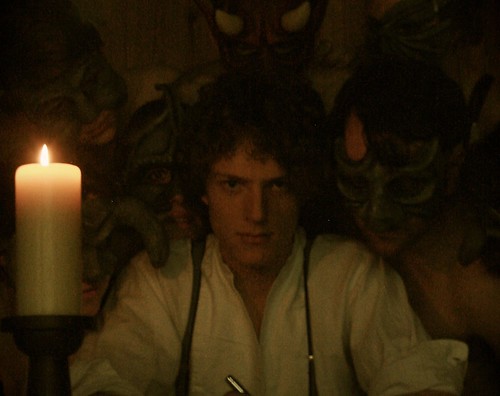
  The tragical history of Dr Faustus achieved a certain notoriety due to the rumours, that circulated from as early as 1594, that a member in the audience nearly caused a riot at a performance -by claiming that he counted an extra devil present on stage midway through the performance! This frightened both the audience and the actors alike. According to some sources, this apparition of an extra devil occurred in more than one performance. It contributed to the reputation of the play as haunted and cursed, which no doubt added to its popularity.

What is a Passion Play?

  A Passion Play is a dramatic production of what is known as the Passion of Christ -his trial, suffering and death. Usually, it depicts from the Last Supper to the Crucifixion, though different countries and denominations perform it with minor adjustments. It is often a traditional part of Lent in many denominations of Christianity, primarily the Catholic denomination.

Thursday, 20 September 2012

The performance of Faustus on stage

  The performance of a play has a great deal of influence on how the audience interpret its content. Since, during Marlowe's time, the stage would have been quite bare, the audience would have to rely on staging, costumes and props in order to read between the lines and understand the parts of the story that weren't actually voiced.
  For example, using different levels of the stage, like the 'above' (a raised platform or balcony), you could depict the relationship between two characters. The characters being present above could represent their separation from the rest of the characters. This separation could be in terms of place or time or even status - so the character above could be higher in status or part of a different timeline.
  As for the costumes, these would have been donated by aristocracy when fashions changed and could be worn to show the status of a character -tattered for poor characters, fairly recent fashions for rich characters. Costumes could also relay the mood of the characters or the atmosphere - bright colours for happy characters or a joyous occasion in the play.
  The props used could also symbolise different elements or themes in the play. For instance, the appaerance of a red handkerchief could imply that the character in possession of it is bleeding. The presence of a few books on stage could show the studiousness and intelligence of a character.
  When I imagine the staging of the first scene with the Good Angel and the Evil Angel, I visualise the Good Angel being above and the Evil Angel being near the above, closer to Faustus who is centre stage facing away from them both, because Faustus ends up following the Evil Angel's advice in the end.

Thursday, 13 September 2012

What is the audience supposed to think of Faustus after the chorus?

  During the chorus, the audience is urged to reserve judgement on Faustus ('To patient judgements we appeal...') which gives the impression that he may have done some pretty unacceptable things but perhaps that he had justifiable reasons that we could sympathise with. The writer also mentions his infancy in the present tense, saying '...now is he born...' , to garner a sense of sympathy.

  With the accounts of Faustus's education that follow, it is easy for the audience to see Faustus as an intelligent and honourable man who has worked his way up in the world. The chorus declares him a man who 'profits in divinity', something that would have been respectable through the deeply religious ages in which our audience lived, and titles him a 'doctor' who happened to study a prestigious university attended many wealthy kings which commends his intelligence since he did not use his non-existent wealth to get in.

  However, the lines that come after this cast a less than favourable light on our protagonist. It is described that abundance of knowledge has caused him to become 'swoln with cunning, of a self-conceit...'. The writer then compares Faustus's tale to the fate of Icharus.
  (According to Greek mythology, Icharus was the son of Daedalus, the craftsman who built the labrinth in which the legendary minotaur resided. Daedalus and his son were imprisoned in the labrinth as punishment for giving Ariadne the clew that she used to help Theseus kill the minotaur and escape the labrinth. In order to escape, Daedalus built a pair of wings out of feathers for both of them and warned Icharus not to fly too close to the sun. But Icharus, giddy with his newfound sense of freedom, did not heed the warning and flew too high -of course! The wax holding the wings together melted, dropping Icharus to his watery death by drowning in the sea.)
(The Greeks like their mythical characters naked apparently. Though I have no idea why anyone would even consider that Icarus would decide to fly naked...)
  This would be construed as a metaphor for Faustus, in his pride, trying to rise too high, too close to God, and being punished for it. The audience would also note the phrase 'heaven conspir'd his overthrow' which implies that the punishment is one from God, and perhaps not entirely his fault.

 The chorus moves on to the subject of necromancy and magic, two ideas that would have been considered unholy or blasphemous, perhaps leading the some in audience to condemn him or at least begin to judge him unkindly. The last line of the chorus reinforces the idea of his intelligence with the mention of Faustus being in his 'study'.

Wednesday, 12 September 2012

Why was there tension between Catholics and Protestants in Elizabethan times?

  Catholics and Protestants had very different beliefs. A major difference in opinion was that Catholics thought that the Pope was connected to God and could grant them salvation whereas Protestants thought that the only way to find salvation was through a direct, personal connection to God. However, their difference in Beliefs was only part of the reason for tension between the two religious factions. Another big influence was politics.

  Before the famous Virgin Queen ascended the throne, her half-sister Mary (as known by the charming sobriquet 'Bloody Mary') ruled England. Mary is well known for restoring Roman Catholicism to England, imprisoning and executing -by burning at the stake- numerous Protestants under Acts of Heresy. In doing this, she instilled anti-Catholic feelings among many of her subjects.

  When Elizabeth, following Mary's death, ascended throne, she restored Protestism to England. Elizabeth tried to be pretty tolerant over religious matters in spite of this, to prevent Catholic revolt. Nonetheless, the Pope rejected her as illigitimate and a heretic, and released her subjects from obedience to her. He threatened Catholics who obeyed her rule with excommunication. He also sent missionaries to England to assist Catholics with plots to overthrow her and place her cousin, Mary, Queen of Scots (yes, another Mary, not a mistake!), on the throne.

  Quite understandably, Elizabeth was not pleased by this and sought to put an end to any such plots. She went about this by persecuting the Catholic clergy, and in the community, excluding Catholics from their professions, fining and imprisoning them if they were suspected of being part of any nefarious plots.

  As a result, there was much tension bleeding into Elizabethan society. Catholics feared and resented the persecution they faced at the hands of non-Catholics whilst Protestants, secure for now, feared Catholic plots to overthrow a monarch who favoured them and resented Catholics for their own past persecution at the hands of the Catholic Queen Mary (the half-sister, that is). Protestants were always on the lookout for offending Catholics to turn in and discriminated against them which caused Catholics to hate them and react bitterly.

You can see this in action in the Lacey Chronicles by Eve Edwards (particularly the first installment, 'The Other Countess'), a series of historical romances for Young Adults.

Monday, 5 March 2012

Does Linda gain a sense of self-awareness by the end of the play?

  In my eyes, Linda doesn't really gain a sense of self-awareness by the end of the play. Nothing in the way she behaves towards Willy or the rest of her family changes. She continues to be passive in relation to Willy's madness -treating him the same way she treated him at the beginning of the play -and mollycoddling him devotedly. There is no evidence that she has learned anything about herself or her situation in life. Happy is still ignored and Biff is still put second when it comes to him and Willy.
  I believe that this in itself is a bit tragic. In the end, she loses Willy -who her whole life seems to revolve around- and gains absolutely nothing from her experiences or from the experiences of others around her. That she must continue her life now without Willy or the comfort of a new purpose or self-awareness is truly tragic in a sense. 

Thursday, 23 February 2012

The restaurant scene

  A number of things occur in this scene from Happy's flirting to Biff's admission of guilt. Biff tells Happy how Bill Oliver did not even recognise him, despairing at his failure. But then he goes on to reveal that he stole a fountain pen from his ex-employer, though he insists he didn't intend to do it. The way he explains it makes him seem like a kleptomaniac and makes me suspect that he really did steal those basketballs from Oliver all those years ago when he left his firm. It also suggests a reason for his not being able to maintain a regular job. For the first time, he seems desperate for his father's approval too, afraid of how he will react to his son's failure.

Sunday, 19 February 2012

My impressions of the end of Act 1(DOAS)

  The end of act 1 reveals to us that Willy has been contemplating suicide which leads us to believe that he is not so completely unaware of the reality of his situation in life as sometimes seems. Linda's strange reaction to her husband's secret shows that she is unsure of how exactly to help him. She enlists the help of her eldest son, Biff, who now has to shoulder this burden and providing for the family. The burden Biff must take on and his putting back his own dreams gives us the impression that Biff is a tragic hero. It is Biff who removes the rubber pipe in the end, taking the decision into his own hands and caring for the welfare of the family.
  The behaviour of the characters at the end of this act helps us round off our ideas on their personalities. For example, the way Happy tries have his own input into the conversation whenever his parents are focussed on Biff shows that he feels like he is fighting to get out of his brother's shadow and be noticed. Willy contradicts himself again when offering Biff advice for his interview, giving the appearance that he wants to seem useful and knowledgeable like a father should -he wants to succeed at something, perhaps live vicariously too- but he makes a bit a of confusing mess of it as usual.
  The end of the act also serves to show us that despite what the rest of the act shows us, Willy is truly proud and admires his eldest son. The neglect and mistreatment of Linda is also highlighted and there are strong hints that Biff is well aware of his father's affair. Linda and Happy could be interpreted as tragic victims through all this.
  At the end of the act, we have assessed the characters and the lives they possess. The play has been set out so we are prepared for the events to come in the second act.

Monday, 21 November 2011

How does Austen create character in Chapter 11 of Pride and Prejudice?

  Austen uses a variety of methods to create character. There are five main ones. At the beginning, the narrator's voice merges with Elizabeth's so we see the characters through her eyes, with her opinions influencing us. As when she writes about Elizabeth finding them to be "agreeable" and describes the air with which they "relate an anecdote".
  Next, we see the way characters are contrasted bringing out their different charcteristics. Such as the way the three men in the chapter are said to behave on entering the room the women have been occupying. The way that Mr Hurst and Darcy behave with polite aloofness appropriate in the present company, defines the contrasting way Bingley responds with such warmth and friendliness.
  The main technique Austen uses to relate the personality of a character is through their interactions with the other characters, through both speech and behaviour toward each other. For instance, the way Darcy "unconciously" closes his book and gives his undivided attention to the women when Elizabeth stands, conveys his attraction to her to the reader. Meanwhile, Elizabeth's teasing speech conveys her witty nature.
  The omniscient narrator relates to us the inner working of the minds of other characters too, so that we may understand them better. We are told that the book Miss Bingley reads provides her with no amusement but she tells the Darcy that "...there is no enjoyment like reading!", this gives us evidence of her ingenuine nature. The way in which she tries to ensnare Darcy's attention repeatedly shows us her careful planning, manipulative side.
  The last way Austen creates character in chapter 11 is through self-realisation. Darcy makes a speech to Elizabeth about his own character in an effort to redeem himself in her eyes. He says he is "resentful" and his "good opinion once lost is lost forever". Hence, a report of character from its very subject.


Thursday, 17 November 2011

Character in Maude Clare

  There are many techniques Rosetti uses to define character in Maude Clare, to mention a few:
-Maude Clare is the title of the poem and the last two words of it. This shows up her dominating, imposing nature and the way she always seems to be the centre of attention. It seems that she is the most powerful character in the poem.
-The way Nell is overshadowed by Maude Clare, both in beauty "...his bride was like a village maid/ Maude Clare was like  queen..." and the way she disappears from the conversation until the end of the poem, shows the polar opposition of her character to Maude Clare. Further proved by her speech, she calls Maude Clare "...more wise, and much more fair..."
- The way the Lord "faltered" goes quite far to prove his weak character. He also "strove to match her scorn with scorn", failing feebly and just repeating the name of the powerful woman addressing him instead. His "fickle heart" convinces us that his mind is easily changed and his character has no strength or determination.

Monday, 31 October 2011

Elizabeth Bennet

  Elizabeth is the central character in Pride and Prejudice. She is perceived to be intelligent and lively, witty and teasing. She presents us with firm independent views, often feministic, which examples her strong but stubborn nature to fix upon one view and be blind to all others. Laughing at others is something she seems to enjoy, making fun of their follies. The way she handles Darcy's snub on their first ball is indicative of this characteristic as she refuses to be put out by his judgement and tells the story with "great spirit" among her friends. Like the narrator she has a capacity for irony. Though her teasing has a gentle undercurrent to it that makes it hard to dislike her despite her harsh words.
  When Lizzie arrives at the Bingleys', her petticoat dirty and face warm after a long walk, it is made obvious that she is active and does not care that others may deem her behaviour unladylike. Her sister, Jane, is very close to her and Elizabeth cares for her very much since she chastises Darcy for ruining Jane's chances of happiness. She does not question Wickham's allegations as she is already prejudiced against Darcy from their very first meeting.
  The confession of Darcy's feelings surprises Elizabeth, but the proud way in which he proposes offends her a great deal, leading her to rebuff him in a manner quite brutal.  Darcy, while expressing his ardent love he reminds her of the large gap in their social status, remarking that Elizabeth could hardly expect him to "rejoice" in her "inferior connections". She outlines her two main reasons for rejection, his interference in her sister's love life and his bad treatment of Wickham, and mentions that he could not have made his proposal in "any possible way that would have tempted" her to accept him. She clearly states her early prejudice against him, saying "I had not known you a month before I felt that you were the last man in the world whom I could ever be prevailed upon to marry".
  However, when Darcy defends his actions in a letter she is horrified and determined not believe him at first, but she finally relents that it is true. She finds her behaviour "despicable" and "humiliating", even admiting she was "blind, prejudiced, partial, absurd". She even sees a little reason in his judgement of her sister and the rest of her family. So we can see that she is not so stubborn that she will delude herself.
  When Elizabeth visits Pemberly, she is heartened by Darcy's pleasant treatment of her aunt and uncle who he would have previously considered his social inferiors. As she mentions near the end, here is where her opinion of him truly began to reverse. But when her youngest sister brings scandal to the family, she fears that Darcy may never feel the same way about her again and laments at it, showing the extent of her feelings for him. She also feels guilty that she made no one aware of Wickham's immoral character before Lydia ran away with him. Finding out that Darcy was the one who aided Lydia's situation only strengthened her affection for him and she refuses to promise that she will never become engaged to Darcy despite the insistence of Lady Catherine.
   At the end when Darcy's second proposal has been accepted, we see that Elizabeth has acknowledged the err of her ways and has changed. She is very much in love with Darcy and believes herself to be happier than Jane. 

Monday, 17 October 2011

The Convent Threshold

  I didn't understand Rosetti's Convent Threshold as much as either of the other poems I had to work on. What was clear was that the major themes of the poem were along the lines of Heaven, Earth, Hell and love. It is commonly believed that the poem is based on the story of Heloise and Abelard, and I can see some parallels there. The ambiguous narrator talks of forbidden love and urges his or her lover to follow him or her to Heaven, where they may be together for eternity.


Thursday, 29 September 2011

A Fallen Woman and her Cousin Kate

  Cousin Kate is another Rosetti poem. I have to say that it is one that I prefer to Goblin Market. Though it is short, it holds a lot of meaning. The poem relates to the theme of fallen women, women who have lost vtheir virtue and have been cast out of society. It tells the tale of a "cottage maiden", who was "contented" and "Not mindful (she) was fair", implying innocence and demureness.
  This narrator describes how she fell in love with a "great lord" and how he "lured" hern to his home to lead a "shameless shameful life", showing us that she gave him her virginity which, though it should have been shameful, felt quite the opposite to her. She explains "he wore me like a silken knot" and describes herself as "his plaything", hinting that he just used her. But then he discarded her, "changed me like a glove", leaving her feeling like "an unclean thing".
  In the third stanza, the narrator addresses "...Lady Kate, my cousin Kate". We are told of how he chose Kate and "cast (her) by". The fourth stanza tells us that the lord "bound" Kate with "his ring". She bitterly comments that the neighbours called Kate "good and pure" and called her "an outcast thing" all gbecause she did not wear a ring.
  The next stanza grows even more bitter and shows the morality of the narrator, a bit ironic considering the fact she is considered a fallen woman -a woman of no morals whatsoever. She describes the love Kate had for the lord as "writ in sand", impying that it was fleeting and easy lost. She tells Kate "if you stood where I stand/ He'd not have won me with his love/ Nor bought me with his land", insinuating that she would not have betrayed Kate or have been bribed by him like she obviously must have been. She shows how truly loyal and strong she would have been when she says that she would have "spit into his face".
  The last stanza, and the best, brings out the strength and resilience of our narrator. She gloats to Kate  "Yet I've a gift you have not/ And seem not like to get", showing that despite being cast out of society she is still strong enough bite back. This gift she describes is the son she has conceived by the lord, who is her "shame" as her is the result of her loss of virtue, but is also her "pride" as any child is to its mother. This son of hers who should make her an outcast, she explains, will inherit his father's land as Kate seems unable to provide the lord with another heir -which grants our narrator power and therefore revenge over the cousin who betrayed her and the lord who jilted her. By the end of the poem, she seems to have the reader on her side, fully supporting her revenge.

Sunday, 25 September 2011

More (make that a lot more) Goblin Market observations

  In the last post, I mentioned four other categories the interpretations of Goblin Market could fall into. In my opinion, it can most largely be interpreted as religious since, as I have mentioned on at least three other blog posts, Rosetti was deeply religious. Allusions to biblical tales can be found at every turn. For example, the 'forbidden fruit' that Laura consumes can be compared to the apple that Eve eats in Genesis. Additionally, the sacrifice Lizzie makes to save her sister can be linked to the crucifixion of Christ. I say this because Lizzie allows herself to be hurt and tortured in order to save Laura, just as Jesus allowed his tortuous death to save the sins of others.
  Feminism is another ever present part of the poem. Notice that we see the main characters are females and their antagonisers are males of the most grotesque nature, the latter could be symbolic of men in general. By the end of the poem, we see the girls triumphing over the goblin men too. The goblin men are rrepresented as monsters who only want to sow their fruits among women, a possible allusion to sex and impregnation. Also, they are portrayed as violent when they beat up Lizzie, implying that men damage women. When Lizzie refuses to 'part her lips', it can be seen as a sign of female resistance. Another thing to notice is that even in the end no males -fathers -are mentioned.    
   Themes of redemption and morality stand tall in this poem. It is presented like a folktale for children, which usually have some kind of moral at the end of them. A bad action takes place and terrible consequences ensue, but eventually all is saved by an ultimate act of redemption that regains her lost 'innocence'. Laura is forgiven and finds the right path again, changing for the better. you could say the moral here is it is never too late to redeem yourself or that there 'no friend like a sister' as the last line preaches.
   Though I am not entirely convinced the elements of an erotic nature are a big part of the poem, I cannot deny that they are present. For instance, the phrase 'unpecked cherries' can be hinting at virginity and the selling of the 'golden curl' for fruits could be symbolic of prostitution. Laura describes the fruits as such that she had 'never tasted before' -perhaps like losing her virginity. Another prominent example that certain members of the class were fascinated by, was the sexual innuendo presented by the lines 'she sucked and sucked and sucked', referring to Laura as she sucked the fruit globes.

Thursday, 22 September 2011

Interpretations-Marxism

  The content of Goblin Market can be interpreted in a number of ways. Five categories they could be put into are erotic, feministic, Marxist, moral and redemption. The one I least understood is the one I had to take a look at in class: Marxist. It was explained to me that this term has much to do with money, commerce and consumerism. Not until really I focused on the poem, did I find anything worth mentioning.
  I noticed that the goblins were calling out, tempting the girls like businessmen. Also like businessmen they seemed deceptive, it is mentioned they were "Signalling each other/ Brother with sly brother" and we see them take what they want from Laura and disappear from her life. Their voices are inviting but appearance is grotesque and true to their nature. They don't want money as they refuse Lizzie's, they want more than that. They ask Laura for her hair, a part of herself, in exchange for the fruits. They want to give people a taste for their product to keep them coming back for more -get them hooked.
  Another similarity between the goblins and businessmen is the way they force their wares on Lizzie -it says "Held her hands and squeezed their fruits/ Against her mouth to make her eat". There are plenty more parts of the poem where we see evidence of hidden Marxism, but these are prominent examples.