Elizabeth is the central character in Pride and Prejudice. She is perceived to be intelligent and lively, witty and teasing. She presents us with firm independent views, often feministic, which examples her strong but stubborn nature to fix upon one view and be blind to all others. Laughing at others is something she seems to enjoy, making fun of their follies. The way she handles Darcy's snub on their first ball is indicative of this characteristic as she refuses to be put out by his judgement and tells the story with "great spirit" among her friends. Like the narrator she has a capacity for irony. Though her teasing has a gentle undercurrent to it that makes it hard to dislike her despite her harsh words.
When Lizzie arrives at the Bingleys', her petticoat dirty and face warm after a long walk, it is made obvious that she is active and does not care that others may deem her behaviour unladylike. Her sister, Jane, is very close to her and Elizabeth cares for her very much since she chastises Darcy for ruining Jane's chances of happiness. She does not question Wickham's allegations as she is already prejudiced against Darcy from their very first meeting.
The confession of Darcy's feelings surprises Elizabeth, but the proud way in which he proposes offends her a great deal, leading her to rebuff him in a manner quite brutal. Darcy, while expressing his ardent love he reminds her of the large gap in their social status, remarking that Elizabeth could hardly expect him to "rejoice" in her "inferior connections". She outlines her two main reasons for rejection, his interference in her sister's love life and his bad treatment of Wickham, and mentions that he could not have made his proposal in "any possible way that would have tempted" her to accept him. She clearly states her early prejudice against him, saying "I had not known you a month before I felt that you were the last man in the world whom I could ever be prevailed upon to marry".
However, when Darcy defends his actions in a letter she is horrified and determined not believe him at first, but she finally relents that it is true. She finds her behaviour "despicable" and "humiliating", even admiting she was "blind, prejudiced, partial, absurd". She even sees a little reason in his judgement of her sister and the rest of her family. So we can see that she is not so stubborn that she will delude herself.
When Elizabeth visits Pemberly, she is heartened by Darcy's pleasant treatment of her aunt and uncle who he would have previously considered his social inferiors. As she mentions near the end, here is where her opinion of him truly began to reverse. But when her youngest sister brings scandal to the family, she fears that Darcy may never feel the same way about her again and laments at it, showing the extent of her feelings for him. She also feels guilty that she made no one aware of Wickham's immoral character before Lydia ran away with him. Finding out that Darcy was the one who aided Lydia's situation only strengthened her affection for him and she refuses to promise that she will never become engaged to Darcy despite the insistence of Lady Catherine.
At the end when Darcy's second proposal has been accepted, we see that Elizabeth has acknowledged the err of her ways and has changed. She is very much in love with Darcy and believes herself to be happier than Jane.
Monday, 31 October 2011

Monday, 17 October 2011
The Convent Threshold
 I didn't understand Rosetti's Convent Threshold as much as either of the other poems I had to work on. What was clear was that the major themes of the poem were along the lines of Heaven, Earth, Hell and love. It is commonly believed that the poem is based on the story of Heloise and Abelard, and I can see some parallels there. The ambiguous narrator talks of forbidden love and urges his or her lover to follow him or her to Heaven, where they may be together for eternity.
Thursday, 29 September 2011
A Fallen Woman and her Cousin Kate

This narrator describes how she fell in love with a "great lord" and how he "lured" hern to his home to lead a "shameless shameful life", showing us that she gave him her virginity which, though it should have been shameful, felt quite the opposite to her. She explains "he wore me like a silken knot" and describes herself as "his plaything", hinting that he just used her. But then he discarded her, "changed me like a glove", leaving her feeling like "an unclean thing".
In the third stanza, the narrator addresses "...Lady Kate, my cousin Kate". We are told of how he chose Kate and "cast (her) by". The fourth stanza tells us that the lord "bound" Kate with "his ring". She bitterly comments that the neighbours called Kate "good and pure" and called her "an outcast thing" all gbecause she did not wear a ring.

The last stanza, and the best, brings out the strength and resilience of our narrator. She gloats to Kate "Yet I've a gift you have not/ And seem not like to get", showing that despite being cast out of society she is still strong enough bite back. This gift she describes is the son she has conceived by the lord, who is her "shame" as her is the result of her loss of virtue, but is also her "pride" as any child is to its mother. This son of hers who should make her an outcast, she explains, will inherit his father's land as Kate seems unable to provide the lord with another heir -which grants our narrator power and therefore revenge over the cousin who betrayed her and the lord who jilted her. By the end of the poem, she seems to have the reader on her side, fully supporting her revenge.
Sunday, 25 September 2011
More (make that a lot more) Goblin Market observations
 In the last post, I mentioned four other categories the interpretations of Goblin Market could fall into. In my opinion, it can most largely be interpreted as religious since, as I have mentioned on at least three other blog posts, Rosetti was deeply religious. Allusions to biblical tales can be found at every turn. For example, the 'forbidden fruit' that Laura consumes can be compared to the apple that Eve eats in Genesis. Additionally, the sacrifice Lizzie makes to save her sister can be linked to the crucifixion of Christ. I say this because Lizzie allows herself to be hurt and tortured in order to save Laura, just as Jesus allowed his tortuous death to save the sins of others.
Feminism is another ever present part of the poem. Notice that we see the main characters are females and their antagonisers are males of the most grotesque nature, the latter could be symbolic of men in general. By the end of the poem, we see the girls triumphing over the goblin men too. The goblin men are rrepresented as monsters who only want to sow their fruits among women, a possible allusion to sex and impregnation. Also, they are portrayed as violent when they beat up Lizzie, implying that men damage women. When Lizzie refuses to 'part her lips', it can be seen as a sign of female resistance. Another thing to notice is that even in the end no males -fathers -are mentioned.
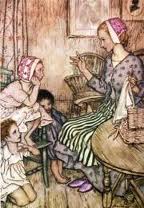 Themes of redemption and morality stand tall in this poem. It is presented like a folktale for children, which usually have some kind of moral at the end of them. A bad action takes place and terrible consequences ensue, but eventually all is saved by an ultimate act of redemption that regains her lost 'innocence'. Laura is forgiven and finds the right path again, changing for the better. you could say the moral here is it is never too late to redeem yourself or that there 'no friend like a sister' as the last line preaches.
Though I am not entirely convinced the elements of an erotic nature are a big part of the poem, I cannot deny that they are present. For instance, the phrase 'unpecked cherries' can be hinting at virginity and the selling of the 'golden curl' for fruits could be symbolic of prostitution. Laura describes the fruits as such that she had 'never tasted before' -perhaps like losing her virginity. Another prominent example that certain members of the class were fascinated by, was the sexual innuendo presented by the lines 'she sucked and sucked and sucked', referring to Laura as she sucked the fruit globes.
Thursday, 22 September 2011
Interpretations-Marxism
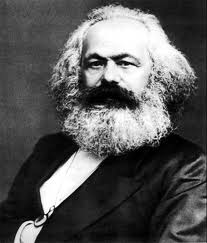 The content of Goblin Market can be interpreted in a number of ways. Five categories they could be put into are erotic, feministic, Marxist, moral and redemption. The one I least understood is the one I had to take a look at in class: Marxist. It was explained to me that this term has much to do with money, commerce and consumerism. Not until really I focused on the poem, did I find anything worth mentioning.
I noticed that the goblins were calling out, tempting the girls like businessmen. Also like businessmen they seemed deceptive, it is mentioned they were "Signalling each other/ Brother with sly brother" and we see them take what they want from Laura and disappear from her life. Their voices are inviting but appearance is grotesque and true to their nature. They don't want money as they refuse Lizzie's, they want more than that. They ask Laura for her hair, a part of herself, in exchange for the fruits. They want to give people a taste for their product to keep them coming back for more -get them hooked.
Another similarity between the goblins and businessmen is the way they force their wares on Lizzie -it says "Held her hands and squeezed their fruits/ Against her mouth to make her eat". There are plenty more parts of the poem where we see evidence of hidden Marxism, but these are prominent examples.
Monday, 19 September 2011
Christina Rosetti -a 19th century poetess
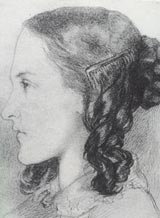 Christina Rosetti was a poet of Italian descent in the nineteenth century. Her father was also a poet. She had two brothers and one sister -two of her siblings also became writers and the other an artist. From the age of fourteen, when she suffered a nervous breakdown, she started to have bouts of depression. It was after this that she, her mother and her sister became interested in the Anglo-Catholic Movement. Rosetti turned deeply religious and refused two of her suitors due to religious reasons.
Her first poem was published at the age of eighteen and Goblin Market at thirty-one. Goblin Market received widespread praise and established Rosetti as the main female poet of the time.
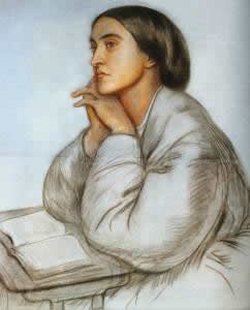 Rossetti was a volunteer worker from 1859 to 1870 at the St. Mary Magdalene "house of charity" in Highgate, a refuge for former prostitutes and it is suggested Goblin Market may have been inspired by the "fallen women" she came to know. She was ambivalent about women's suffrage, but many scholars have identified feminist themes in her poetry. She was opposed to slavery (in the American South), cruelty to animals (in the prevalent practice of animal experimentation), and the exploitation of girls in under-age prostitution.
 Feminists held her as symbol of constrained female genius, placed as a leader of 19th century poets. Her work strongly influenced the work of such writers as Ford Madox Ford, Virginia Woolf, Gerard Manley Hopkins, Elizabeth Jennings, and Philip Larkin. Critic Basil de Selincourt stated that she was "all but our greatest woman poet … incomparably our greatest craftswoman … probably in the first twelve of the masters of English verse". Rossetti is honoured with a feast day on the liturgical calendar of the Episcopal Church (USA) on April 27.
Friday, 16 September 2011
Rosetti and Goblin Market
On taking a closer look at the first 140 lines of the poem, I could see more religious themes coming out along with elements of innocence and temptation. Laura's golden hair seems like her innocence or her soul -a part of her she has to lose to pay the price for giving in to temptation. The goblins are represented by quite grotesque imagery and are all men. They are said to be sly, making us suspicious of them but their voices are kind and "honey-toned". The list of fruits in the first part seems to me like a list of temptations on offer that will eventually lead to sins. Though Laura was the first to caution her sister, she was also the first to succumb to temptation. Once she has consumed the fruit, Laura is addicted and the reader can clearly see that it isn't going to end well.


Subscribe to:
Posts (Atom)